
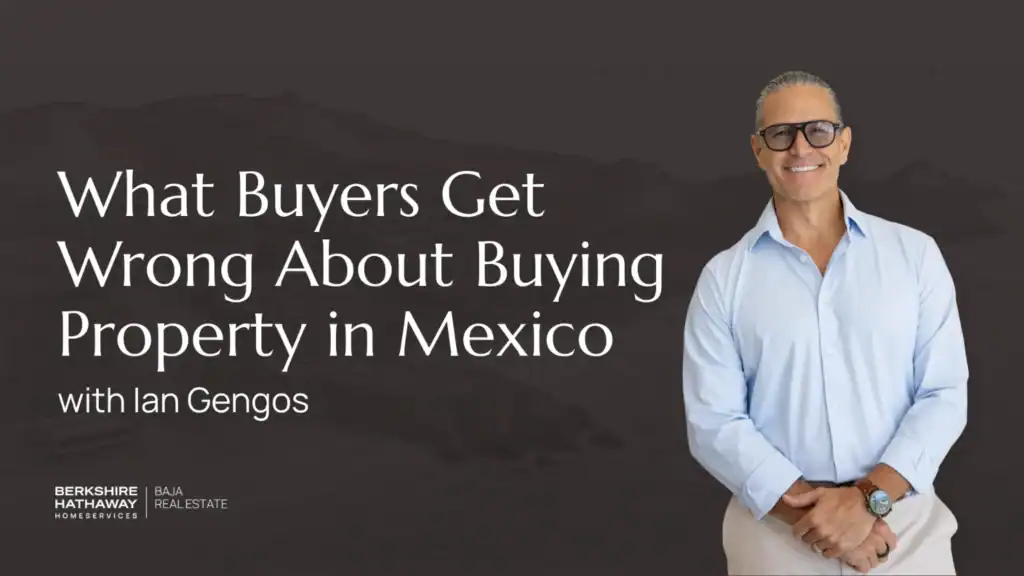
Ask Ian Gengos, Owner and Managing Broker of Berkshire Hathaway HomeServices Baja Real Estate, what buyers get wrong here and he does not start with price, timing or location. He starts with something simpler.
“You don’t know what you don’t know.”
Ian Gengos
Then the specific version of it. Ian says what some buyers get wrong is that “they assume that things work the same here as they do where they’re from. And that can be as benign as opening a bank account to something as complex as a real estate transaction.”
He is careful to say this is not the same as difficult: “there are nuances that you need to observe and be aware of and work with a local to help you get around. Otherwise those bumps could be pretty significant potholes in the process.”
There are two of those potholes worth more than the rest. One stops people before they start. The other costs them money after they have committed.
The first: believing you cannot own it
Ian puts the misconception plainly: “you as a foreigner cannot own real estate in Mexico and that you’re leasing a property for X number of years. That is not the case.”
As a foreigner, you can buy real estate in Mexico fee simple.
Ian Gengos
In Los Cabos, that ownership runs through a bank trust, and it is still ownership. Not a lease, not a license, not a fixed term that expires and leaves you with nothing. You can sell it, rent it, renovate it and leave it to your children.
This belief is specific and sticky. Buyers have usually heard, second hand, that Mexico offers foreigners something like a long lease. They then either dismiss the market or arrive braced for a compromise that does not exist.
The trust is where the confusion comes from. Mexican law designates areas near the country’s borders and coastlines where foreign buyers hold title through a bank trust, a fideicomiso, rather than directly, and Los Cabos sits inside that zone. A Mexican bank holds title as trustee, you hold every beneficial right, and the arrangement renews. You are not renting from the bank and the bank cannot sell your house.
The mechanics are a separate subject and we have written them up properly. What a trust costs, which banks act as trustee, what happens when one exits the business, and how to confirm your own are all in our guide to fideicomiso costs in Los Cabos. That page is about the money. This one is about the misconception.
The second: not asking whether the developer can finish
This is the expensive one, and it is specific to a market that has been building fast.
Ian describes a pattern he has watched repeatedly, and it starts with people arriving from elsewhere in Mexico as much as from abroad. In his words: “They come over to Cabo and they say, that’s a really great piece of land. Let me buy that land and throw up a condo building and make a million dollars. Well, you didn’t contemplate the infrastructure. You didn’t determine that you were going to get electric permits once the building was done.”
In the clip he follows that with the end state: a community with very limited water supply and no plan to fix it, three quarters of a condo building that cannot be finished because the capital for the pool has run out, nobody buying, and a dozen others in the same position nearby.
The buyer’s exposure in that scenario is not the quality of the finish. It is whether the project completes at all.
What makes it worse is how reasonable the decision felt at the time. The renderings were good, the developer was confident, the deposit went in to secure a stage. What did not happen was anybody checking whether the person taking the deposit could finish the building without it.
Ian’s test is one question, and it is the most useful sentence on this page:
“How far along can he get in his plan before he needs to rely on sales to finish? And if the sales dry up, you got no project.”
Ian Gengos
That is a question about capitalization, not about the drawings. It is answerable. Ask who is funding the project, what is already built and paid for, what the permit position is for utilities and occupancy, and what happens to deposits if the project stalls. A buyer who asks it has a materially different risk profile from one who likes the renderings. The contract terms, warranties and cancellation rights that protect you are in our guide to buying pre-construction in Los Cabos.
One note on the deposit figure in the clip. Ian mentions a hundred thousand dollars. He is voicing a hypothetical buyer to make the pattern concrete, not quoting a market norm. Deposits vary by project and by stage, and yours should be set out in the contract rather than inferred from an anecdote.
The questions worth asking before you commit
None of these require you to know anything about Mexican property law.
- Does this property sit in an area that requires a bank trust, and is one already in place? An existing trust can sometimes be assumed, which changes the cost and the timeline.
- Who is the trustee bank, and is it currently active in that business? Banks enter and leave this market, and an owner needs to know where their own trust sits.
- On anything pre-construction, how far can the developer get without sales revenue? And what happens to your deposit if they cannot.
- What is the permit position for utilities and occupancy, as opposed to the permit to build.
- Who is acting for me? The notario has a defined public role in the transaction and is not your advocate. We have written about the difference between a notario and a lawyer.
- What does the full cost look like, itemized? Not a single blended percentage. Buyer closing costs in Los Cabos breaks down what sits inside that number.
The short version
You can own property in Los Cabos as a foreigner and leave it to your children. In the coastal zone you do it through a bank trust, which is a structure rather than a limitation. And on anything not yet built, the question that matters is not what it will look like, it is whether the person building it can finish without your money.
Ask us anything specific about a property you are considering and we will tell you which structure applies and, on a pre-construction project, what we can establish about the developer.
Frequently Asked Questions
Can a foreigner own property in Mexico?
Yes. In Los Cabos you own it through a fideicomiso, a bank trust that gives you every right of ownership. The belief that foreigners can only lease is the most common misconception about this market, and it is wrong.
Do I actually own it, or does the bank own it?
You own it. In the restricted coastal zone a Mexican bank holds title as trustee of a fideicomiso while you hold every beneficial right: to live in it, rent it, renovate it, sell it and leave it to your heirs. The bank is an administrator, not an owner.
What is a fideicomiso?
A bank trust used by foreign buyers in Mexico’s restricted zones. A Mexican bank holds title, you hold the beneficial rights, and the trust renews. The costs and the trustee banks are covered in our guide to fideicomiso costs.
How do I check a developer is financially sound before buying pre-construction?
Ask how far they can get on their own capital before they need sales revenue to finish. If sales slow and the answer is “not far”, there may be no project. Then ask what is already built and paid for, what the utility and occupancy permit position is, and what happens to your deposit if the project stalls.
What actually goes wrong on a stalled project?
Ian’s description is a building that reaches three quarters finished and stops, because the capital ran out before the amenities were built, with nothing selling and similar projects stalled nearby. The buyer’s money is in a building that does not exist yet.
Is buying pre-construction in Los Cabos a bad idea?
No. It is a different risk from buying something standing, and it is a risk you can investigate before committing rather than discover afterwards.
Should I work with an agent on a pre-construction purchase, or go direct to the developer?
Going direct is where several of the problems in Ian’s account began, because nobody independent did the due diligence on the developer’s funding. An advisor acting for you is the person who asks those questions on your behalf.
What is the single most useful thing I can do as a first-time buyer here?
Work with somebody local who does these transactions regularly, and test them with specific procedural questions early. A good advisor answers them without hesitating.