
These three get talked about as though they were points on a single scale, with beachfront at the top and an ocean view further down.
They are not. They are three different purchases, each with its own question attached, and the question is different in each case. Answering the wrong one is how a property that was exactly as described turns out not to be what was wanted.
This page sets out what each one is really buying you, and the single check that matters most for each.
Beachfront: the question is where your property ends
What you are buying is proximity and exposure, and they arrive together. The sound and the light are the reason people pay the premium. The salt, the wind and the humidity are the reason the maintenance is higher, and our guide to buying a beachfront home covers the structural and insurance side in detail.
The check that matters most is where your property actually ends.
Buying on the beach does not mean owning the beach. Mexico treats the strip along the shore differently from the land behind it, and what a beachfront owner may and may not do with the area in front of their property is a specific legal question with a specific answer for each property.
When we put this question to the AI assistants, every one of them warned us about it and none explained how to check it. So here is how to check it.
The federal zone runs twenty meters inland from the high tide line, which is about sixty-five feet. Building into that strip, or extending a property into it, is prohibited, and a federal concession is what would be required for it.
Your property’s actual footprint is on record in two places, and they should agree: the metes and bounds in the property deed, and the record held at the municipal tax office. Both show the government-recognized footprint of the lot, which is the thing that matters rather than where a fence or a terrace currently sits.
The four checks, in order
- Read the metes and bounds in the deed. This is the legal description of what you are buying, and it is the document that governs.
- Compare it against the municipal tax office record. Two independent records of the same footprint. If they disagree, that is a question to resolve before you commit, not after.
- Ask SEMARNAT whether a concession exists over the federal zone in front of the property. If a terrace, a pool, a palapa or a wall sits seaward of your boundary, a concession is what would have been required for it. Whether one exists is a question of record, and it is one to settle before you commit rather than after.
- Hire a surveyor to confirm the lot map on the ground. Documents describe a footprint. A survey tells you whether the structures match it.
That sequence answers the question for a specific property, which is the only level at which it can be answered. Anyone offering you a general assurance about beach rights has skipped all four steps.
This reflects our latest information and can change. Ask us to help with those checks on a property you are considering. We can help you obtain the deed description and the municipal record, and introduce you to the surveyors and attorneys we work with, so the questions get asked before you make an offer rather than after.
An agent who can walk you through that clearly, for the specific property, with documents, has told you a great deal about how many of these transactions they handle.
Golf: the question is whether membership comes with the house
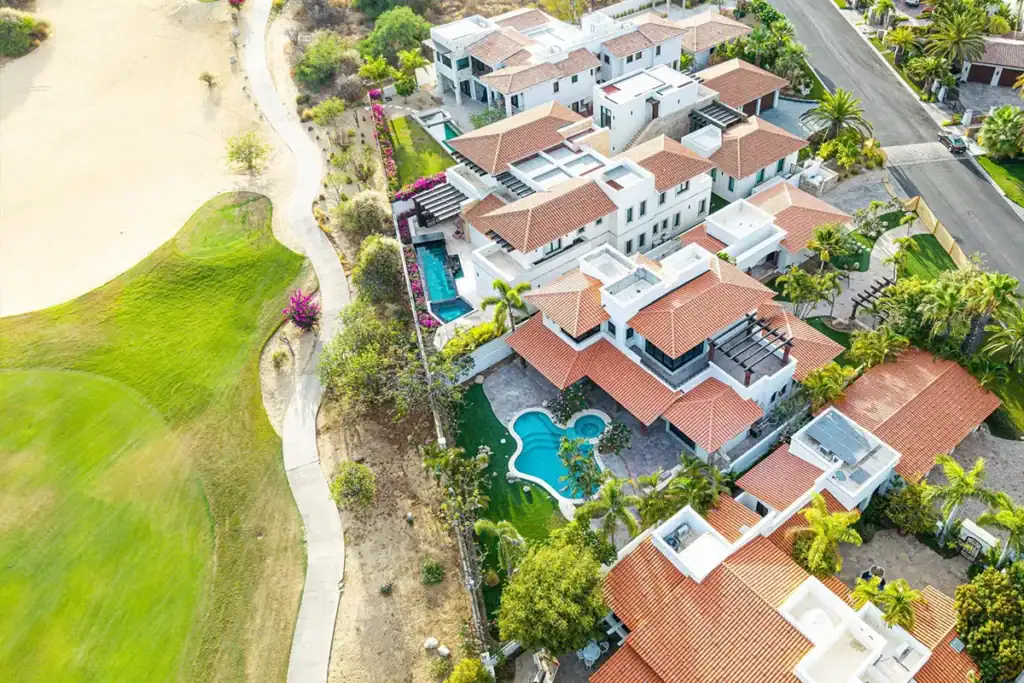
What you are buying is a setting and a community. The course is the organizing principle of the development, and in practice it is also what sets the standard of the landscaping, the security and the roads.
The check that matters most is whether club membership conveys with the property.
The two are not the same purchase. Owning a home on a golf community does not automatically make you a member of the club, and the two are frequently separate: separately owned, separately governed and separately priced. A property may come with a membership, with the right to apply for one, with a transferable membership that has its own cost, or with none of those.
Ask, before you fall in love with the terrace:
- Does a membership convey with the property, or is it separate?
- If separate, what does it cost to join, what are the annual dues, and is there a waiting list?
- Is membership transferable when you sell, and on what terms?
- What do the community dues cover, and is course access among them?
The difference between a property with a conveying membership and an otherwise identical one without is real money, and it is not always reflected in the asking price.
Our pages on the individual golf communities set out what each one offers.
Ocean view: the question is what can be built in front of you
What you are buying is the view, and the question is whether anybody else can build in front of it.
The check that matters most is what may be built between your property and the water.
A view is a function of the land in front of it, and that land belongs to someone. If it is undeveloped, the relevant question is not whether it is beautiful now but what is permitted on it: how high, how close to the boundary, how much of the plot may be covered.
Ask:
- Who owns the land between the property and the water, and is it developed?
- What may be built on it: height limits, setbacks and coverage rules?
- Is it inside the same community, and therefore subject to the same design rules?
- Has anything been submitted or approved for it?
A view protected by a community’s own design rules, or by land that cannot be built on, is a materially different asset from one protected by nothing but the current owner’s inertia.
There is also a positive version of this. An elevated position two rows back can hold a more durable view than a front-row property, with less salt exposure, because what protects it is height and distance rather than the goodwill of whoever owns the plot in front. That trade is worth considering explicitly rather than by default.
What all three share
Renting may change your tax rate. The municipality sets different predial rates according to how a property is used, so a property let out is not automatically the same case as one you occupy. Ask the treasury what rate applies to the property you are considering and on what basis. Our predial guide goes into how the charge is worked out and how to find what a specific property pays.
Community rules decide what a renter may use. In Los Cabos this is rarely a flat ban on renting and is usually about which amenities a renter may access. That is what changes the nightly rate, so read the rules rather than asking whether renting is “allowed”.
The trust and the acquisition tax are the same whichever you choose.
The question behind the question
How much of the year will you be here, and what will you do when you are?
Someone who will swim every morning is buying something different from someone who will look at the water from a terrace with a coffee. Beachfront’s premium is paid mainly for the first. Ocean view serves the second at a lower cost and with lower maintenance. Golf serves a use of the property rather than a view of it.
That is not a ranking. It is the question the three options are actually answering differently.
What we cannot tell you
Prices, or the premium for each. The community pages carry current inventory, which is a better source than a general rule.
What the beach access position is for your specific property. The four checks above establish it, and they have to be run on the individual property. What we can tell you is the framework and how to verify it, which is what that section does.
Membership costs at any club. Club-specific and they change.
Rental returns. We hold no verified figures and will not publish an estimate.
Frequently Asked Questions
Does buying beachfront in Los Cabos mean I own the beach?
No. The federal zone runs twenty meters inland from the high tide line, about sixty-five feet. Building or extending into it is prohibited, and a federal concession is what would be required for it. Your own footprint is described in the deed and recorded at the municipal tax office, and a surveyor can confirm it on the ground.
How do I check where a beachfront property actually ends?
Four steps, in order. Read the metes and bounds in the deed. Compare them against the municipal tax office record. Ask SEMARNAT whether a concession exists over the federal zone in front of the property. Then have a surveyor confirm the lot map on the ground.
What happens if a structure sits inside the federal zone?
Building or extending into that strip is prohibited, and a federal concession is what would be required for it. Whether one exists for a particular structure is a matter of record that SEMARNAT can confirm, and your attorney is the person to tell you what it means for a purchase. That is why the check belongs before an offer rather than after.
Does buying in a golf community include club membership?
Not automatically. The club and the residential community are frequently separate, and a membership may convey, be available to apply for, be transferable at a cost, or not be available at all. Ask before you commit.
Can someone build in front of my ocean view?
That depends on who owns the land between you and the water and what is permitted on it. Establish ownership, height limits, setbacks and coverage rules, and whether the land is inside the same community and subject to its design rules.
Is beachfront always more expensive than ocean view?
We do not publish price comparisons, because the ranges move and the two categories overlap more than people expect. Our community pages carry current inventory across both, which is a better basis than a general rule.
Does beachfront cost more to maintain?
Salt, wind and humidity all bear on a building closer to the water. Our guide to buying a beachfront home covers the structural, roofing and insurance considerations.
Does it matter which I choose if I want to rent it out?
The community’s rules on what a renter may use matter more than the property type, and the municipality sets different predial rates according to how a property is used, so ask the treasury what applies to the property you are considering.
Which holds value best?
We are not going to answer that with a rule. It depends on the specific property, the community and what protects the thing you paid the premium for, which is the point of the three checks above.
Whichever of the three you are leaning toward, the questions that decide it are specific to a property rather than to a category. Talk to us about the ones you are actually considering, and we will help you establish what sits in front of them, what can be built there, and who to ask about the running costs.